





If your skin seems to change almost overnight somewhere in your forties, there is a biological reason, and it starts earlier than most women expect.
It begins in perimenopause, often in your early forties, and it builds toward a striking figure: in the five years after menopause, women lose around 30% of the collagen in their skin. Not across a lifetime. In five years.
You are not imagining the speed, and you have not started doing something wrong. The creams that used to work stop keeping up, your face looks flatter and drier, and it happens faster than it had any right to. There is a name for what is happening, and it has been everywhere online lately: the Collagen Cliff.
“Does collagen actually work?” is the question I am asked more than any other, and the honest answer has been buried under a lot of noise. So let us settle it properly: what the cliff really is, how much of the online panic is earned, and whether taking collagen does anything about it.

In this article
What the collagen cliff actually is
Start with what collagen is, because the scale surprises people. It is the most abundant protein in your body, roughly a third of all the protein you are made of, and in skin it is the scaffolding that keeps everything firm, thick and springy.
Everyone loses it with age. From our mid-twenties we shed it slowly, at around 1 to 1.5% a year. That gentle slope comes for all of us.
Menopause is a different scale of loss. The 30% drop in the first five years, first measured in a 1987 study and confirmed many times since, lands on top of that background decline, then continues at about 2% a year for the next fifteen. The slope becomes a cliff.
Now the part worth staying level-headed about. The phrase “collagen cliff” is new, and it has been travelling around social media with a good deal of doom attached to it. The science underneath it is not new in the slightest: researchers have been documenting what menopause does to skin since the 1940s. So the cliff is real, the biology is settled, and the panic is a little oversold. You are not falling off anything. You are moving down a known, measured, manageable slope, and understanding its shape is most of the battle.
It tends to start earlier than women expect, in perimenopause, the run-up that can begin in your early forties when hormones first start to swing. That timing is why so many women describe their skin changing “out of nowhere.” It was not ‘nowhere’. It was the cliff, arriving on schedule.
It’s really about oestrogen, not collagen
The collagen cliff is not fundamentally a collagen problem. It is an oestrogen problem.
Your skin is a hormone-sensitive organ, in the same club as bone and breast tissue. The fibroblasts that produce collagen carry oestrogen receptors, and oestrogen both switches collagen production on and keeps the enzymes that stabilise collagen fibres working properly. For most of your adult life, oestrogen has been doing a large share of the work that keeps skin firm, without ever sending you the invoice.
When it falls through perimenopause and menopause, two things happen together. Your skin builds less new collagen, because the signal to build has weakened. And existing collagen breaks down faster. Production down, breakdown up, and the gap between them is what you see as thinner, looser, drier skin.
That is why the change feels sudden, and why a heavier moisturiser does not fix it. This is not surface ageing. It is the maintenance system itself winding down.
It tracks hormonal age, not your birthday
Here is the fact that surprises almost everyone: collagen loss follows your hormonal age, not your chronological age.
It is the years since your hormones began shifting that predict the loss, not the year you were born. Which is why two women who are both exactly 50 can look genuinely different, with the same sun exposure and the same lifestyle. If one entered perimenopause at 42 and the other at 52, they are simply standing at different points on the same cliff. The changes are not random, and they are not a report card on your willpower. They follow a pattern, and a pattern is something you can plan around instead of endure.
So does taking collagen actually work after 40?
The short answer: collagen supplements can improve skin hydration and elasticity, but after 40 the results depend on whether your skin can still use the raw material.
The research on oral collagen is more positive than the sceptics claim and more limited than the marketing suggests. Both are true at once.
Several placebo-controlled studies have found that collagen supplements can improve skin hydration and elasticity and soften the look of wrinkles over a few months of consistent use. So yes, collagen can help skin, midlife included.
But two catches matter enormously after 40. The first is the mechanism. When you swallow collagen, it does not travel to your face intact. Your body breaks it down into amino acids and small peptides, and you have little say in where they end up. You are handing over raw material and hoping your skin chooses to spend it on skin.
The second catch is the bigger one, because it does not touch the real problem. After 40 you are not simply short on collagen. Falling oestrogen has slowed the machinery that builds it and sped up the machinery that breaks it down. Tipping in more raw material does nothing about why your skin got worse at using it in the first place. What you want in this decade is to help your skin build its own collagen again, not just to feed it more.
Why most collagen supplements for women over 40 fall short
This is where a lot of collagen products let midlife skin down, through no fault of the person taking them.
Most are animal-derived collagen, from cattle or fish. You take a big dose, your gut breaks it into its parts, and the rest is left to chance. That is one reason many women go looking for a vegan collagen alternative. But vegan or not, more raw material alone does not solve the real problem. For younger skin, with the hormonal signal still intact, a big dose of peptides can be enough to show results. For skin that has gone over the cliff, where the build signal itself has faded, more raw material is only half an answer.
What is usually missing is anything that helps skin actually assemble collagen from those parts, and anything that slows the faster breakdown running alongside it. Feeding the body more collagen leaves both untouched.
What actually helps
Before any supplement, a few things have strong evidence behind them and are worth getting right first.
Protein and vitamin C. Collagen is built from amino acids, so getting enough protein matters, and many women under-eat it in midlife. Vitamin C is the non-negotiable partner: your body physically cannot build collagen without it. To see how tight that link is, look at scurvy, the disease that killed more sailors than storms and combat combined. It is essentially collagen collapse from a lack of vitamin C, with old wounds reopening and skin coming apart. You are nowhere near that, but it shows exactly how dependent your collagen is on the cofactor.
Daily sun protection. UV is one of the biggest drivers of collagen breakdown, and that damage stacks on top of the hormonal loss. Daily SPF is one of the most effective anti-ageing steps there is. More on that in what summer does to your skin after 40.
Resistance training. Building and keeping muscle supports skin, bone and tissue health through the menopausal transition.
Hormones, with your doctor. For some women, hormone therapy is an appropriate option that affects skin among much else. That is an individual medical decision, so it belongs with your doctor, not a blog.
With those foundations in place, the supplement question gets more precise. Not “should I take collagen,” but “what helps my skin rebuild collagen now that it has become worse at doing so.”
How the AVEA Collagen Activator fits in
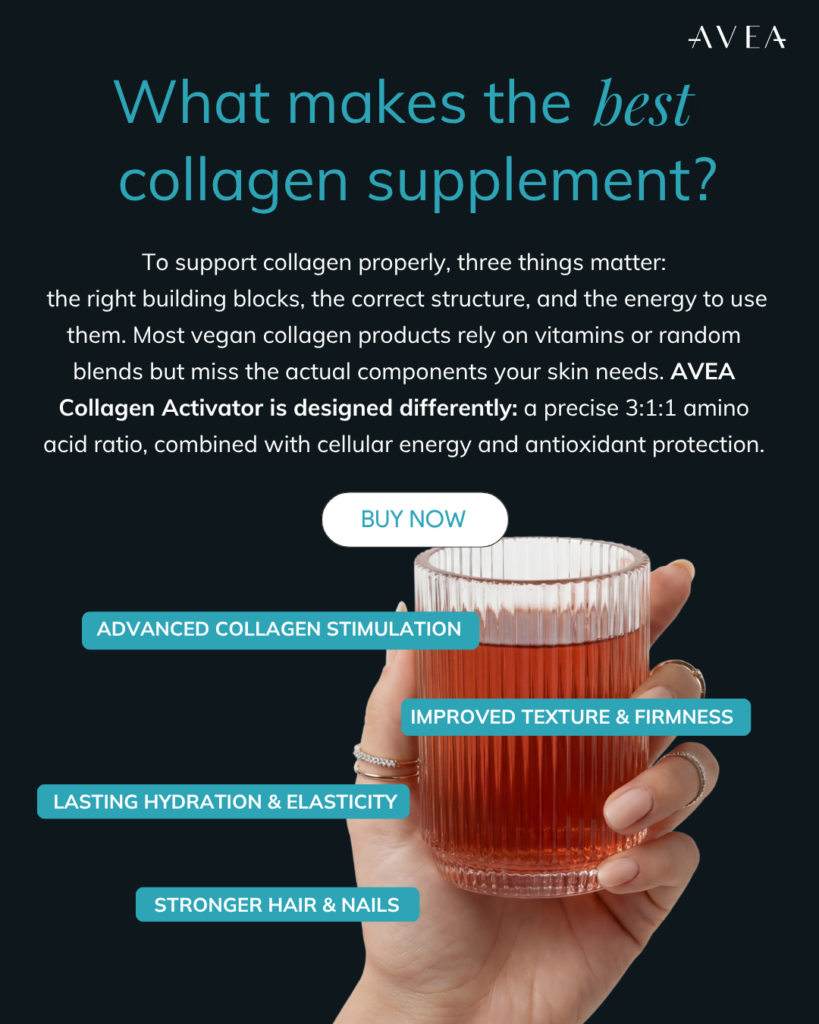
This is the exact problem we built the AVEA Collagen Activator to solve, and it is why it is not another tub of animal collagen powder, but a vegan collagen approach built for what changes after 40.
Rather than supplying collagen and hoping your body uses it, the Collagen Activator gives your skin the tools to make its own, which is the part that falters after 40.
Colgevity™, the building blocks in the right ratio. A patented, 100% vegan collagen precursor delivering the three amino acids your body builds collagen from, glycine, proline and hydroxyproline, in the 3:1:1 ratio research points to as optimal. Developed with scientists at ETH Zurich, it has been shown to convert into new collagen up to 4 times more efficiently than standard collagen supplements.
Vitamin C from acerola cherry, the cofactor. The nutrient your body cannot assemble collagen without, so the building blocks can be put to use.
Astaxanthin, to defend. An algae-derived antioxidant that helps protect skin against the oxidative stress that drives collagen breakdown.
Calcium alpha-ketoglutarate (Ca-AKG), to support repair. A cellular-energy and longevity ingredient that supports the repair processes behind collagen renewal.
In AVEA’s own clinical study, taking the Collagen Activator improved skin hydration by 30% within one month, reduced the appearance of wrinkles, and over six months was associated with a measurable reduction in biological age. It is vegan, made in Switzerland, and comes as a once-a-day sachet you stir into water.
In short, it is built to do the three things plain collagen cannot after the cliff: supply the right building blocks, help your skin use them, and defend the collagen you still have.
(If dryness, sensitivity and a weakened moisture barrier are your main midlife concern, that is a related but separate story, covered in our guide to the skin barrier. To support collagen and barrier together, the Skin Longevity Bundle pairs the Collagen Activator with our SkinSpan™ supplement.)
The takeaway
So, does collagen work after 40? It can help. But the sharper question in this decade is not whether to take collagen, it is how to help your skin rebuild it once falling oestrogen has made that harder.
The collagen cliff is real, it is hormonal, and it is predictable. Predictable is the good news, because it means you can meet it with a plan: eat enough protein, get your vitamin C, wear SPF daily, keep your muscle on, take your hormone questions to your doctor, and give your skin real support to build collagen, through precursors it can actually use, rather than more powder to digest.
None of that means doing everything. It means doing the few things that matter, and starting sooner rather than later. You are not falling off a cliff. You are walking down a slope you can finally see.
References
- Brincat M, Kabalan S, Studd JW, Moniz CF, de Trafford J, Montgomery J. A study of the decrease of skin collagen content, skin thickness, and bone mass in the postmenopausal woman. Obstetrics & Gynecology. 1987;70(6):840-845.
- Brincat MP, Baron YM, Galea R. Estrogens and the skin. Climacteric. 2005;8(2):110-123.
- Shuster S, Black MM, McVitie E. The influence of age and sex on skin thickness, skin collagen and density. British Journal of Dermatology. 1975;93(6):639-643.
- Pullar JM, Carr AC, Vissers MCM. The roles of vitamin C in skin health. Nutrients. 2017;9(8):866.
- AVEA Collagen Activator (Colgevity™) clinical trial: reversing biological age and improving skin elasticity, hydration, and texture. AVEA Longevity Insights.