






Did you know there is an easy test you can perform at home without any equipment to estimate how long you will live? Your ability to move through space is one of the most accurate predictors of how long you will live. While many people focus on heart rate or blood pressure as the primary markers of health, the Sitting-Rising Test (SRT) reveals a more fundamental biological truth. It measures how well your musculoskeletal system, neurological coordination, and core stability work together.
The Sitting-Rising Test is a simple, no-equipment assessment. You sit cross-legged on the floor and then attempt to stand back up. You begin with a perfect score of 10. Every time you use a hand, knee, forearm, or side of your leg for support, you lose one point. If you lose your balance, you lose half a point.
In this article

The clinical implications of this test are significant. A study published in the European Journal of Preventive Cardiology followed over 2,000 adults aged 51 to 80 for more than six years. The researchers found that participants who scored in the lowest range (0 to 3) were 5 to 6 times more likely to die during the study period than those in the highest scoring group (8 to 10). Each one-point increase in the score was associated with a 21% reduction in all-cause mortality.
In simplified way the points in the test have the following meaning:
| Score Range | Survival Categorization | Risk Analysis |
| 8 to 10 | Low Risk | Excellent musculoskeletal fitness; minimal risk of mobility-related mortality. |
| 3.5 to 7.5 | Moderate Risk | You are 2–3 times more likely to die within the next 6 years compared to high-scorers in the same age group |
| 0 to 3 | High Risk | You are 5–6 times more likely to die within the next 6 years compared to high-scorers in the same age group |
The Sitting-Rising Test: The Biology of Functional Decline
To understand why the SRT predicts mortality, we have to look at what is happening at the cellular and structural levels. Sitting down and standing up requires the synchronization of three critical systems: skeletal muscle power, joint flexibility, and neurological balance.
The natural process of progressive loss of muscle mass and quality with age is called sarcopenia. This process often accelerates after age 50. It specifically affects Type II “fast-twitch” muscle fibers, which are responsible for explosive movements and the ability to catch yourself if you stumble. When these fibers atrophy, your ability to generate the upward thrust needed to stand without assistance diminishes.
The connective tissues in our body responsible for joint flexibility undergo biochemical changes too. Collagen, the most abundant protein in the body and the primary structural component of our tendons, ligaments, and cartilage, begins to degrade. In a healthy state, collagen fibers are evenly aligned, providing a net-like support that is both strong and elastic. With age and oxidative stress, these fibers become cross-linked and “sticky” due to the formation of Advanced Glycation End-products (AGEs). This cross-linking makes tendons stiffer and cartilage more brittle, restricting the range of motion in the hips, knees, and ankles required for floor-based movements.
Finally, the SRT tests your proprioception, which is the body’s ability to sense its position in space and balance itself. This requires rapid communication between the peripheral nerves in your joints and the brain. If your neurological processing is slowed by systemic inflammation or poor metabolic health, your balance falters. The SRT exposes these hidden physiological weaknesses before they manifest as chronic disease or a life-altering fall.
Why Muscular Power Outweighs Aerobic Capacity
We have been conditioned to believe that cardiovascular endurance is the ultimate metric of longevity. While heart health is vital, the SRT proves that functional strength and flexibility are equally critical. You can have a strong heart, but if your musculoskeletal system cannot support your weight or recover from a loss of balance, your “healthspan”—the period of life spent in good health—will be severely truncated.
Musculoskeletal health is an active metabolic organ. Skeletal muscle helps regulate blood glucose, manages systemic inflammation, and secretes myokines, which are signaling molecules that communicate with the brain and the immune system. A low score on the SRT indicates that these metabolic processes are likely impaired.
When a person scores below a 5 on the test, it usually points to a “functional gap.” This is the distance between the physical demands of daily life and the body’s actual capacity to meet them. When this gap narrows, the risk of injury increases, and the body’s “metabolic reserve” disappears. This is why the test is so predictive of mortality; it measures the body’s overall resilience to physical stress.
Improving Your Score: The Functional Intervention
If you perform the test and find your score is lower than expected, it is a signal for intervention. Improving your mobility is not merely about “stretching” or “going for walks.” It requires a targeted approach to rebuild the biological foundations of movement.
The first priority is protecting the structural integrity of the joints. Since the SRT requires deep flexion in the knees and hips, your cartilage and ligaments must be resilient. Supplementing with specific collagen precursors can help. Traditional hydrolyzed collagen is often insufficient because the body must break it down and reassemble it. A more sophisticated approach uses specific amino acids like Glycine, Proline, and Hydroxyproline in precise ratios to stimulate the body’s endogenous collagen synthesis.
The second priority is reducing systemic inflammation. Chronic, low-grade inflammation (often called “inflammaging”) degrades muscle tissue and stiffens the extracellular matrix. Ingredients like highly bioavailable Curcumin (such as the HydroCurc® formulation) and Maritime Pine Bark extract help modulate inflammatory pathways. This reduces the “stiffness” often felt in the morning or after exercise, allowing for the greater range of motion required by the SRT.
The third priority is cellular energy. To stand up without using your hands, your leg muscles need an immediate burst of ATP (adenosine triphosphate). This depends on mitochondrial health. As we age, NAD+ levels decline, which impairs mitochondrial function. Increasing NAD+ through precursors like NMN can support the cellular energy required for high-force movements.

The Avea Approach: Designing for Functional Longevity
At Avea, we do not view supplements as generic “wellness” products. We view them as designed interventions to bridge the functional gaps that the Sitting-Rising Test exposes. Our formulations are built to address the specific biological bottlenecks of ageing.
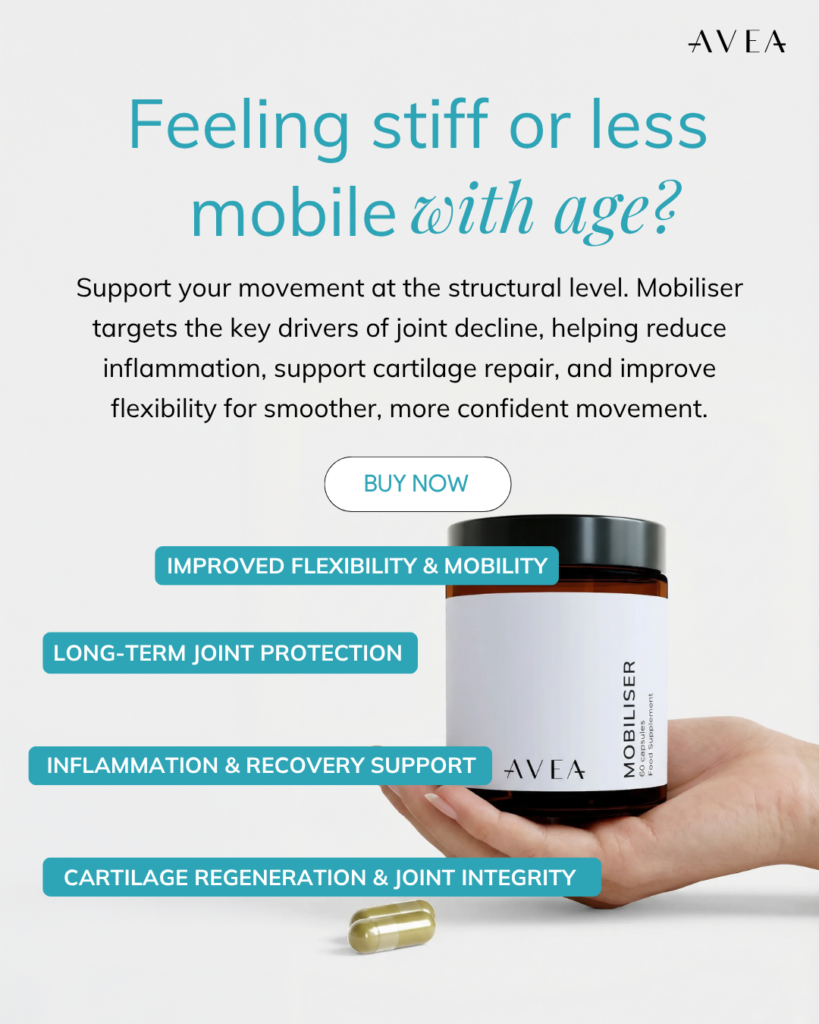
If the SRT exposes joint stiffness or a lack of structural resilience, the Mobiliser is the logical intervention. Unlike standard joint supplements that rely on large doses of poorly absorbed glucosamine, the Mobiliser uses a triple-action mechanism. It combines UC-II® (undenatured type II collagen), which works with the immune system to promote cartilage repair, with HydroCurc® for rapid inflammation reduction, and Maritime Pine Bark to increase joint flexibility. This directly addresses the “triad” of joint pain: inflammation, oxidative stress, and cartilage damage.
For those whose SRT score is limited by skin and connective tissue elasticity, the Collagen Activator provides the specific building blocks. It utilizes our patent-pending Colgevity™ blend, providing the body with the exact amino acids needed to restart collagen production from within, rather than relying on external bovine or fish sources that the body may not utilize effectively.
Finally, because functional movement requires cellular power, the NAD+ Vitaliser or NMN supports the mitochondrial health necessary for muscle force. By raising NAD+ levels, you are optimizing the energy available for every fiber involved in the rising phase of the test.
Moving Beyond the 10-Second Mark
The Sitting-Rising Test is a powerful diagnostic, but it is not a fixed destiny. It is a baseline from which you can build. By understanding the biology of your movement—the need for collagen integrity, the necessity of low inflammation, and the requirement for cellular energy – you can take control of your longevity.
True longevity is not just the absence of disease; it is the maintenance of function. It is the ability to interact with your environment, play with your grandchildren, and move through the world with confidence and without pain.
If your score is low, start today. Incorporate strength training that focuses on the legs and core. Practice the movement itself. Support your biology with the specific nutrients it needs to repair and energize. The SRT is your 10-second warning; how you respond to it will define the next several decades of your life.
Would you like to explore a curated routine specifically designed to support the joint and muscle health required for functional mobility?
FAQs
What is a good score on the Sitting-Rising Test?
A score of 8 to 10 is generally considered strong. It suggests that mobility, balance, coordination, and lower-body strength are well preserved. A lower score does not predict a specific outcome on its own, but it can indicate that movement quality, joint function, or muscular power need attention.
Why does the Sitting-Rising Test matter for longevity?
The test combines several systems at once. It reflects lower-body strength, joint mobility, balance, coordination, and the ability to control body weight through space. Those functions are closely tied to independence, fall risk, and physical resilience with age.
Does a low score mean I am unhealthy?
Not necessarily. A low score is not a diagnosis. It is a functional signal. It can highlight limitations in strength, flexibility, balance, or movement confidence that may deserve attention before they turn into bigger problems.
Can you improve your Sitting-Rising Test score?
Yes. Many people can improve their score by training lower-body strength, hip and ankle mobility, balance, and floor-to-stand control. Repeating the movement over time can also improve confidence and coordination. Specific supplementation with strong anti-inflammatory ingredients like Curcumin and maritime pine bark extract like the AVEA Mobiliser can support your mobility.
What usually makes the score worse with age?
The biggest contributors are loss of muscle power, reduced joint mobility, poorer balance, stiffness in connective tissue, and reduced confidence moving close to the floor. These changes often build gradually, which is why the test can be useful as an early warning sign.
Is the Sitting-Rising Test safe for everyone?
No. People with significant knee pain, hip problems, recent surgery, severe balance issues, dizziness, or high fall risk should be cautious. It is better to try it near a stable support or with supervision if movement confidence is low.
What is the fastest way to support a better score?
The biggest gains usually come from combining leg and core strengthening with mobility work for the hips, knees, and ankles. Movement quality improves further when inflammation, recovery, and connective tissue support are also addressed.