


If you’re researching senolytics, you’ve likely asked yourself: Should I take Quercetin or Fisetin? Or both? And what about the other compounds that support cellular health?
The biohacker community often debates individual supplements versus comprehensive formulations. This article breaks down the science of senolytics, compares individual molecules, and explains why strategic combinations may offer advantages over isolated compounds.
What Are Senolytics?
Senolytics are compounds that selectively induce death (apoptosis) in senescent cells—often called “zombie cells.” These are damaged cells that have stopped dividing but refuse to die. Instead, they accumulate with age and secrete inflammatory molecules (the Senescence-Associated Secretory Phenotype, or SASP) that:
- Damage neighbouring healthy cells
- Promote chronic inflammation
- Accelerate tissue dysfunction
- Contribute to age-related diseases
Unlike antioxidants that protect cells or anti-inflammatories that reduce symptoms, senolytics actually remove the source of the problem by eliminating senescent cells from tissues.
The Senolytic Mechanism
Senescent cells resist apoptosis through upregulated survival pathways, particularly:
- BCL-2 family proteins (anti-apoptotic)
- PI3K/AKT signalling (cell survival)
- p53 resistance pathways
Effective senolytics disrupt these pathways, making senescent cells vulnerable while leaving healthy cells largely unaffected.
In this article
Quercetin vs. Fisetin: Head-to-Head Comparison
Quercetin: The Foundational Senolytic
Primary mechanism: Inhibits anti-apoptotic pathways (BCL-2, BCL-xL), disrupts PI3K/AKT signalling
Senolytic potency: Moderate; effective in certain cell types, particularly senescent endothelial cells
Additional benefits:
- Strong antioxidant (scavenges free radicals)
- Anti-inflammatory (inhibits NF-κB and NLRP3 inflammasome)
- Cardiovascular support (improves endothelial function via nitric oxide)
- Neuroprotective properties
Research dose: 500-1,000 mg daily in clinical studies
Bioavailability note: Standard quercetin has limited absorption, but advanced delivery systems (phytosome technology) can dramatically enhance bioavailability—up to 20-fold improvement
Best for: Cardiovascular health, inflammatory conditions, broad antioxidant support
Fisetin: The More Potent Senolytic
Primary mechanism: More potent inhibition of survival pathways; activates apoptosis via PI3K/AKT and mTOR modulation
Senolytic potency: Superior to Quercetin in preclinical studies; effective across multiple senescent cell types
Additional benefits:
- Neuroprotection (activates protective proteins)
- Reduces SASP more effectively than Quercetin
- Extended lifespan in animal models
- Anti-inflammatory effects
Bioavailability: Also limited with standard extracts
Research dose: 100-500 mg daily (some studies use intermittent high-dose protocols)
Best for: Direct senescent cell clearance, neuroprotection, targeted senolytic effect
The Verdict?
Fisetin demonstrates stronger senolytic activity in research, particularly for directly eliminating senescent cells across diverse tissue types. However, Quercetin offers broader systemic benefits and cardiovascular protection.
The pioneering senolytic research by Kirkland, Tchkonia, and colleagues at Mayo Clinic actually used Quercetin + Dasatinib (a pharmaceutical), suggesting that Quercetin’s value may be maximized in combination rather than isolation.
Beyond Senolytics: Why Cellular Health Requires a Multi-Pronged Approach
Here’s the limitation of focusing only on senolytics: they address only one hallmark of ageing. Comprehensive cellular health requires:
- Senolysis – Removing existing zombie cells
- Senescence prevention – Protecting healthy cells from becoming senescent
- Autophagy – Clearing damaged proteins and organelles before they trigger senescence
- Mitochondrial health – Maintaining energy production and reducing oxidative stress
- Antioxidant defence – Neutralizing free radicals that damage DNA and proteins
Taking Quercetin or Fisetin alone addresses only the first point.
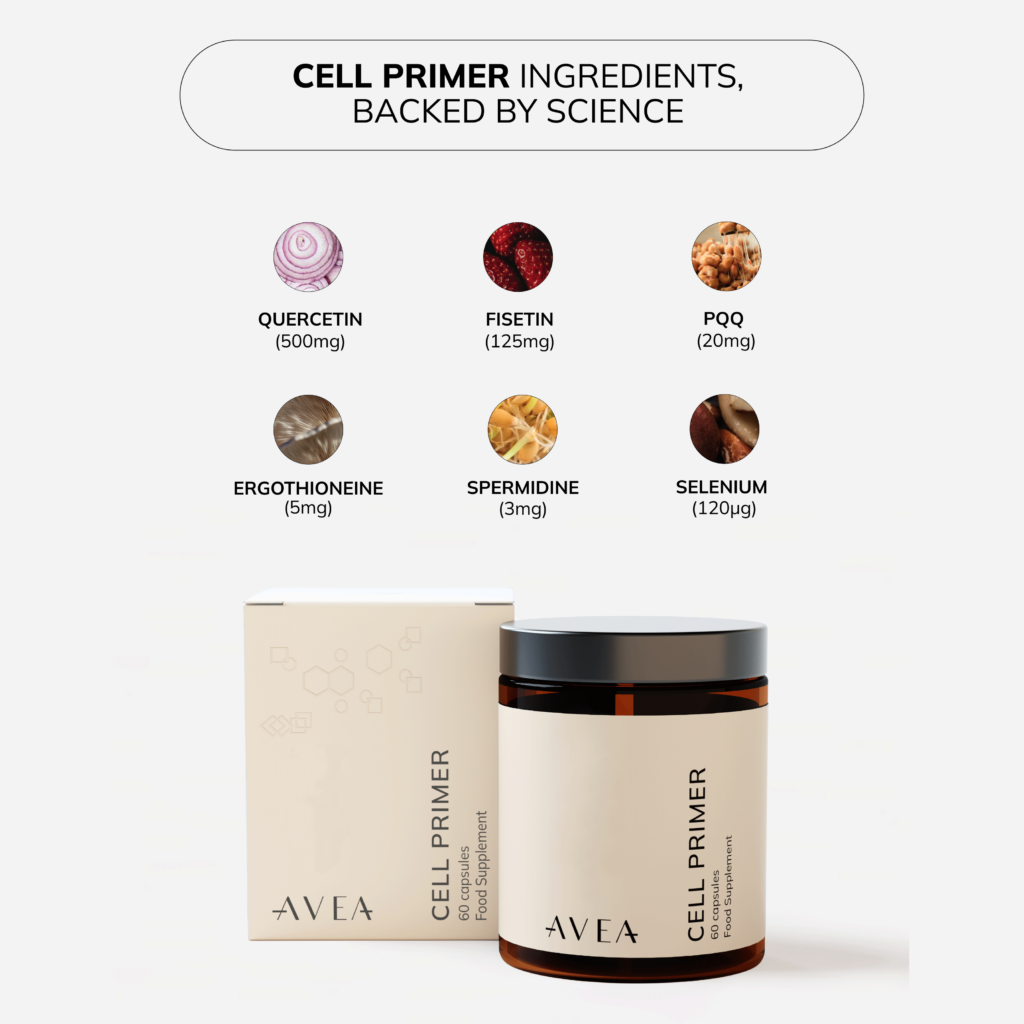
The Synergistic Formulation: AVEA Cell Primer
Cell Primer was designed on a fundamental principle: combine complementary mechanisms to address cellular ageing comprehensively.
Here’s how each ingredient contributes and why they work better together:
1. Dual Senolytics: Quercefit® Quercetin (500 mg) + Fisetin (125 mg)
Why both?
- Different mechanisms: Quercetin targets BCL-2 family proteins; Fisetin works through PI3K/AKT and mTOR pathways
- Broader cell-type coverage: Different senescent cells respond to different senolytics
- Research precedent: Mayo Clinic’s pioneering work used combination senolytic therapy
- Quercetin’s role: Provides cardiovascular and anti-inflammatory benefits while supporting senolysis
- Fisetin’s role: Delivers more potent direct senolytic effect with neuroprotection
The bioavailability advantage: Quercefit®
Cell Primer uses Quercefit®, not standard quercetin. This matters significantly.
Standard quercetin suffers from poor water solubility and low absorption—only about 20% of an administered dose typically reaches the bloodstream. This is why many supplements require high doses (1,000+ mg) to achieve effects.
Quercefit® uses phytosome technology, where quercetin molecules are bound to phospholipids (from sunflower lecithin), creating a complex that’s absorbed 20 times more effectively than standard quercetin. The phospholipid acts as a delivery vehicle, helping quercetin dissolve and cross intestinal membranes far more efficiently.
What this means practically:
- 500 mg of Quercefit® ≈ 10,000 mg of standard quercetin in terms of bioavailability
- Achieves therapeutic blood levels at lower doses
- More consistent absorption across individuals
- Better tolerability (no need for mega-doses that can cause digestive issues)
Clinical studies demonstrate that Quercefit® maintains activity for immune support, inflammatory response modulation, and physical performance at these optimized doses.
The synergy: By targeting multiple survival pathways simultaneously with highly bioavailable quercetin plus fisetin, the combination eliminates senescent cells more effectively than either compound alone—while using lower total doses than you’d need with standard quercetin.
2. Spermidine: The Autophagy Activator
Dose: 3 mg (from 300 mg Wheat Germ Extract)
Why it’s included:
Autophagy is your cells’ recycling system—it breaks down and removes damaged proteins, lipids, and organelles before they cause enough damage to trigger senescence.
Mechanism: Spermidine inhibits acetyltransferases and activates autophagy-related genes (ATGs), essentially turning up your cellular clean-up system.
The synergy with senolytics:
- Senolytics remove cells that are already senescent
- Spermidine prevents healthy cells from becoming senescent by clearing damage early
- Together, they reduce both existing zombie cells and the formation of new ones
Additional benefits: Cardiovascular health, improved mitochondrial quality, associated with reduced all-cause mortality in observational studies
3. PQQ: Mitochondrial Biogenesis and Mitophagy
Dose: 20 mg
Why it’s critical:
Damaged mitochondria are a primary driver of cellular senescence. They produce excessive reactive oxygen species (ROS) that damage DNA, proteins, and lipids—pushing cells toward the senescent state.
Mechanism: PQQ activates PGC-1α and CREB signalling pathways, which:
- Stimulate creation of new mitochondria (biogenesis)
- Promote selective removal of damaged mitochondria (mitophagy)
- Enhance ATP production and energy metabolism
The synergy with senolytics and autophagy:
- Senolytics clear senescent cells
- Autophagy (Spermidine) clears damaged cellular components
- PQQ specifically targets mitochondrial quality—the energy factories that, when damaged, accelerate senescence
Additional benefits: Neuroprotection via nerve growth factor (NGF), improved cognitive function, enhanced cellular energy
4. Ergothioneine: The Longevity Antioxidant
Dose: 5 mg
The unique factor: Humans evolved a dedicated transporter (OCTN1) specifically for Ergothioneine—suggesting evolutionary importance. It concentrates in mitochondria and stem cells.
Why it’s included:
Oxidative stress damages DNA and proteins, directly triggering senescence. Ergothioneine provides targeted protection where it matters most.
Mechanism:
- Scavenges reactive oxygen and nitrogen species
- Protects mitochondrial membranes and DNA
- Accumulates in stem cells, preserving regenerative capacity
The synergy: While senolytics remove damaged cells, Ergothioneine protects healthy cells (especially stem cells) from the oxidative damage that would make them senescent. It’s a defensive strategy complementing the offensive senolytic approach.
Why you can’t get enough from food: You’d need over 100g of cooked mushrooms daily to match the 5 mg supplementation dose.
5. Selenium: The Foundation of Antioxidant Defence
Dose: 120 µg (as L-Selenomethionine, 218% NRV)
Why it’s essential:
Selenium is a cofactor for glutathione peroxidases and thioredoxin reductases—your body’s primary antioxidant enzyme systems.
Mechanism:
- Enables enzymatic neutralization of ROS
- Supports thyroid function and metabolic regulation
- Protects against oxidative DNA and protein damage
The synergy: Selenium provides the enzymatic antioxidant defence (ongoing protection), while Ergothioneine offers direct ROS scavenging. Together, they create a comprehensive antioxidant shield that prevents oxidative stress—one of the strongest triggers of cellular senescence.
The prevention angle: Selenium doesn’t clear zombie cells, but it significantly reduces the oxidative burden that creates them in the first place.
Why Combination Beats Isolation: The Scientific Rationale
1. Multiple Hallmarks of Ageing
Research identifies at least 12 hallmarks of ageing. Cell Primer targets five simultaneously:
- Cellular senescence (Quercetin, Fisetin)
- Loss of proteostasis (Spermidine via autophagy)
- Mitochondrial dysfunction (PQQ)
- Oxidative stress (Ergothioneine, Selenium)
- Stem cell exhaustion (Ergothioneine)
2. Prevention + Intervention
- Senolytics (Quercetin + Fisetin): Remove existing damage
- Autophagy activation (Spermidine): Prevent future damage
- Mitochondrial support (PQQ): Maintain energy and reduce ROS production
- Antioxidant defence (Ergothioneine + Selenium): Shield against oxidative triggers
3. Bioavailability and Dosing Optimization
Individual supplementation faces challenges:
- Taking 5-6 separate supplements daily (compliance issue)
- Getting ratios wrong (too much of one, too little of another)
- Timing issues (some compounds work better together)
- Cost inefficiency (buying separately is often more expensive)
4. Research-Backed Ratios
Cell Primer’s formulation reflects clinical research:
- Quercetin 500 mg: Based on Mayo Clinic senolytic protocols
- Fisetin 125 mg: Within the range shown effective in preclinical models
- Balanced support compounds: Doses that complement senolytic action without redundancy
When Individual Supplements Make Sense
Choose standalone Quercetin if:
- Your primary goal is cardiovascular health or allergies
- You’re already taking comprehensive longevity supplements
- You want maximum flexibility in dosing
Choose standalone Fisetin if:
- You’re specifically targeting senescent cell burden
- You’re following intermittent high-dose senolytic protocols
- Neuroprotection is your primary concern
Choose a combination formula like Cell Primer if:
- You want comprehensive cellular health support
- You value convenience and optimized ratios
- You’re interested in synergistic effects
- You want to address multiple ageing pathways simultaneously
The Practical Reality: Why Biohackers Choose Formulations
The most sophisticated biohackers understand that cellular health isn’t about finding the “one” perfect compound—it’s about orchestrating multiple mechanisms.
Consider this scenario:
Approach A – Individual supplementation:
- Fisetin 125 mg: €25/month
- Quercetin 500 mg: €18/month
- Spermidine: €30/month
- PQQ: €28/month
- Ergothioneine: €35/month (if you can find it)
- Selenium: €8/month
- Total: €144/month + managing 6 bottles
Approach B – Synergistic formulation:
- Cell Primer: All ingredients in research-backed ratios, one daily dose
Beyond cost, there’s the cognitive load of:
- Tracking what works and adjusting
- Researching optimal doses for each compound
- Timing doses appropriately
- Ensuring purity and quality across multiple brands
Conclusion: Strategic Cellular Support
The question isn’t “Quercetin vs. Fisetin”—it’s “How can I most effectively support cellular health?”
Senolytics are powerful, but they’re one tool. Comprehensive cellular health requires:
- Eliminating zombie cells (senolytics)
- Preventing new senescent cells (autophagy, antioxidants)
- Maintaining mitochondrial quality (biogenesis support)
- Protecting against oxidative damage (targeted antioxidants)
Cell Primer was designed to deliver all of this in one evidence-based formulation.
If you’re committed to optimizing longevity at the cellular level, the most efficient path forward isn’t choosing between individual compounds—it’s choosing a strategic combination that addresses the full spectrum of cellular ageing.